
The Nigerian Writer Who Knows People Are Not Just One Thing — Adesanya Pelumi Ayomide

Picture this. You have an idea that refuses to leave your mind. It follows you through ordinary days. You think about it while working, resting, perhaps even in the middle of conversations. You tell yourself that one day, you will finally do something with it. But one day becomes another. Then another. Eventually, the question is no longer whether the idea is good enough. It is whether you are brave enough to bring it to life.
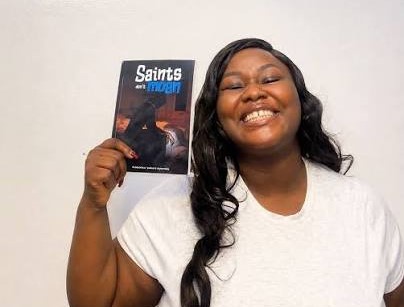
For some writers, the journey from an idea to a published book is straightforward. For others, it is marked by hesitation, self-doubt, unfinished drafts, and the fear of placing their work in the hands of readers. Adesanya Pelumi Ayomide knows that journey. Her debut novel, Saints Don’t Moan, began with a simple but unsettling question:
What if people are not always who they appear to be?
This is the story of Adesanya Pelumi Ayomide, a writer whose first novel invites us to look beyond the labels we give people and, perhaps, the labels we give ourselves. Because sometimes, the most compelling stories begin where appearances end.

Who She Is
Adesanya Pelumi Ayomide does not describe herself simply as a writer. In fact, she seems almost deliberately resistant to being placed inside a single identity. She is curious. She loves learning. She loves stories.
Writing is an important part of her life, but she sees herself as someone who is constantly learning, questioning, creating and trying to understand life and people. Alongside writing, she works as an education officer and HR practitioner. That combination tells us something about the person behind Saints Don’t Moan.
Her interest in people does not exist only on the pages of her book. It is part of how she experiences the world. She is fascinated by the contradictions within human beings. People can be loving and selfish. Kind and flawed. Generous and complicated. Sometimes all at once. That fascination has become one of the defining characteristics of her writing. Perhaps it is why she is drawn to complicated characters rather than perfect ones.
As a child, Pelumi was quiet and was the only girl among three boys. She describes herself as curious and eager to learn. Her relationship with books developed naturally through her family, particularly through her eldest brother, who would bring books home from school. She would read them, gradually building the reading habit that would become such an important part of her life.
Her reading was eclectic. She remembers The Joys of Motherhood and Things Fall Apart, alongside Lantern books and Hollywood books that could be found cheaply as thrift. That detail is small, but revealing. The future author of Saints Don’t Moan did not grow up waiting for one particular book to give her permission to become a writer. She simply loved stories. And she kept reading them. There is another side of Pelumi that may surprise people who meet her.
She says she can appear calm, gentle and easygoing, but internally, there is a great deal happening. She observes. She thinks. She analyses conversations from different angles. She notices people’s behaviour, their words and even their silences. She describes herself as both optimistic and playful and, at the same time, capable of being extremely hard on herself. She can be curious and adventurous while also overthinking herself into staying still.
That contradiction may be one of the keys to understanding her fiction. She does not believe people are ever simply one thing. And neither, apparently, does she. That makes her less interested in creating characters who fit neatly into categories of hero and villain. Instead, she seems interested in what exists between those categories. The good person who does something terrible. The flawed person capable of kindness. The person who wants to appear perfect. The person hiding something they are ashamed of.
The person who makes one terrible decision and then has to live with everything that follows. That is where Pelumi’s curiosity seems to lead her. Into the complicated spaces people would rather not examine.

The Book
| Title | Saints Don’t Moan |
| Publisher | Self-Published | ACEworld Publishers |
| Year | 2026 |
| Genre | Thriller, Psychological Fiction |
| Language | English |
| Award | Winner, Best Thriller Book, The Africa Laureate Awards 2026 |
| Available | ACEworld Publishers, Amazon, and other major book retailers |
Every book has an origin story. For Saints Don’t Moan, it began when a friend called Pelumi a “bad person” during an argument. The comment made her question how easily people mistake appearance for character. Because she seemed calm and gentle, her friend had assumed she was inherently good. This led Pelumi to wonder how often people are trusted simply because they look trustworthy, or get away with wrongdoing because they do not fit the image of a suspect.
That idea became the foundation of Saints Don’t Moan, with Kiki Cole at its centre. Pelumi describes Kiki as an alter ego, a creative way to explore aspects of herself and human behaviour without making the story directly autobiographical. Kiki embodies Pelumi’s fascination with contradiction: she can appear good and trustworthy while hiding a darker side.
Through Kiki, Pelumi asks a deeper question: what if everyone has a Kiki within them? What if people are neither completely good nor completely bad? The title Saints Don’t Moan reinforces this idea. Its deliberate paradox and sexual innuendo challenge society’s expectations of those considered “good.” We expect saints to be perfect, free from desire, mistakes, and contradictions. Yet real people rarely fit such neat definitions.
At its heart, the book explores one central truth: people are not one thing. Good people can do bad things, and flawed people can contain goodness. When society demands perfect images, people may go to great lengths to hide their mistakes, sometimes causing more damage than the original wrongdoing. Saints Don’t Moan therefore becomes not only a story about secrets, but also about the human desire to control how others see us and what happens when that carefully constructed image begins to collapse.
Bad people have good in them, and good people have bad in them. People are not one thing.
— Adesanya Pelumi Ayomide

The Writing Journey
Pelumi began writing Saints Don’t Moan around September 2025, during a difficult period in her life. She had noticed that writing came more naturally when she was struggling, with her emotions and questions becoming material for stories. She completed the first draft on November 14, 2025, and shared it with friends for feedback.
Finishing the manuscript, however, did not immediately make her feel like an author. Instead, self-doubt took over. She questioned whether the book was good enough, whether anyone would read it, and whether publishers would accept it. Anxiety made her hesitant to submit the manuscript, and at one point, she gave up.
Encouraged by friends, Pelumi eventually sent the manuscript to beta readers, whose feedback restored some of her confidence. The turning point came when ACEworld Publishers read the manuscript and expressed their belief in the book, offering to begin the publishing process.
What began as an idea on Pelumi’s laptop became more than a published book. Saints Don’t Moan was named Winner, Best Thriller Book at The Africa Laureate Awards 2026, marking a significant milestone in her journey as a writer. More importantly, the journey taught her that the greatest obstacle between an aspiring writer and a published book is often not a lack of ideas, but the fear that those ideas may not be good enough.
Pelumi’s journey shows that sometimes the most important step is simply finishing, then finding the courage to let others read what you have created.
Just write it. It doesn’t matter how long it takes. Take your time, write the story and let it become what it needs to become.
— Adesanya Pelumi Ayomide
The Wit
There is something amusing about writing a dark story and then having everyone who knows you wonder how much of it is actually you. Pelumi experienced exactly that. After reading Saints Don’t Moan, some assumed it was autobiographical, while others were surprised by her dark imagination and the book’s reflective depth.
She finds these reactions funny because readers naturally connect writers to their characters. We assume the villain reflects the author, the romantic scenes really happened, or the secrets must have come from somewhere. Sometimes they do, but fiction also allows writers to explore possibilities without confessing to them.
Kiki is Pelumi’s alter ego, but she is also a vehicle for exploring human contradictions. A calm, seemingly predictable writer can create a character with a dark side because, as the book suggests, people are rarely as simple as they appear.
Even the title plays with this contradiction. A “saint” is expected to be pure, restrained and beyond ordinary weakness. But what if the saint has desires, makes mistakes, or hides something? What if the desire to appear saintly creates the greatest danger?
Pelumi’s wit lies in challenging simple categories. She makes readers look twice at the people they think they understand, and perhaps, in the process, at themselves.

What She Teaches
If Saints Don’t Moan teaches anything, it is that perfection can become dangerous when people feel forced to perform it. Pelumi’s biggest takeaway is that everyone has flaws or guilty pleasures they may prefer to hide. Sometimes, she suggests, acknowledging those imperfections is less destructive than pretending they do not exist.
Kiki embodies this idea. Her betrayal of her best friend is terrible, but her greater mistake comes from trying to protect her image. Fear of being exposed leads her to kill her friend, triggering an increasingly destructive chain of events. The lesson is uncomfortable: people can cause more damage hiding their mistakes than admitting them.
This moves the story beyond entertainment into an exploration of shame, judgment, reputation and accountability. Pelumi’s message is not that wrongdoing should be excused, but that people should have room to acknowledge their flaws without becoming prisoners of the identities they have constructed.
Her central philosophy is that people are rarely one thing. They can be kind and selfish, brave and afraid, generous and complicated. One mistake does not have to define an entire person.
Perhaps the lesson for readers is simple: leave room for complexity. Before judging others, remember that you may not know their whole story. Before judging yourself, remember that one mistake does not have to become your identity. And before demanding perfection from someone else, remember that you are asking a human being to behave like something they are not: a saint.
The Invitation
Beneath Saints Don’t Moan is the story of a woman who had long wanted to write a book but had to overcome the fear that she was not good enough. She wrote it, doubted it, nearly gave up, received encouragement and feedback, and eventually found a publisher who believed in her manuscript.
Since Saints Don’t Moan, Pelumi has continued exploring storytelling, including a dark romance novel and other writing projects. She hopes to be remembered as a writer unafraid to explore uncomfortable aspects of human nature and challenge readers to look beyond appearances.
Her journey ultimately proves a simple truth: you cannot wait for fear to disappear before you begin. Sometimes, you have to write while doubting yourself, finish while uncertain, and send the story into the world anyway. A story cannot find its reader while it remains hidden inside its writer.
And when you are ready to give your own story that chance, ACEworld Publishers is here to guide you from manuscript to publication. From manuscript development and professional publishing to global distribution, we help authors transform their ideas into books ready to meet the world.
Because every published book begins with a writer who decides that their story deserves to be told.
The Literary Spotlight is a weekly editorial column on the ACEworld Blog celebrating the authors shaping the future of African literature. To nominate an author for a future edition, contact us.
