The Engineering Student Who Wrote a Crime Thriller on His Phone and Brought Lagos Its Own Robin Hood
Picture this. A sixteen-year-old boy in Lagos, fresh off a fanfiction phase and a short-lived stint on Wattpad, decides — for reasons he still cannot fully explain — that he wants to write a novel. Not a school essay. Not a notebook story with a hand-drawn cover, the kind he had been making since he was eleven. A real novel, the kind he had only ever seen written by adults in faraway places, about detectives and killers and the kind of pulse-pounding crime fiction he loved to read but had never once seen set among Nigerian characters in a Nigerian city.
He did not have an agent. He did not have a publisher waiting. He did not even have a laptop he could rely on. What he had was a phone, a vague premise, and the kind of audacity that belongs only to teenagers who have not yet been told no enough times to stop believing.
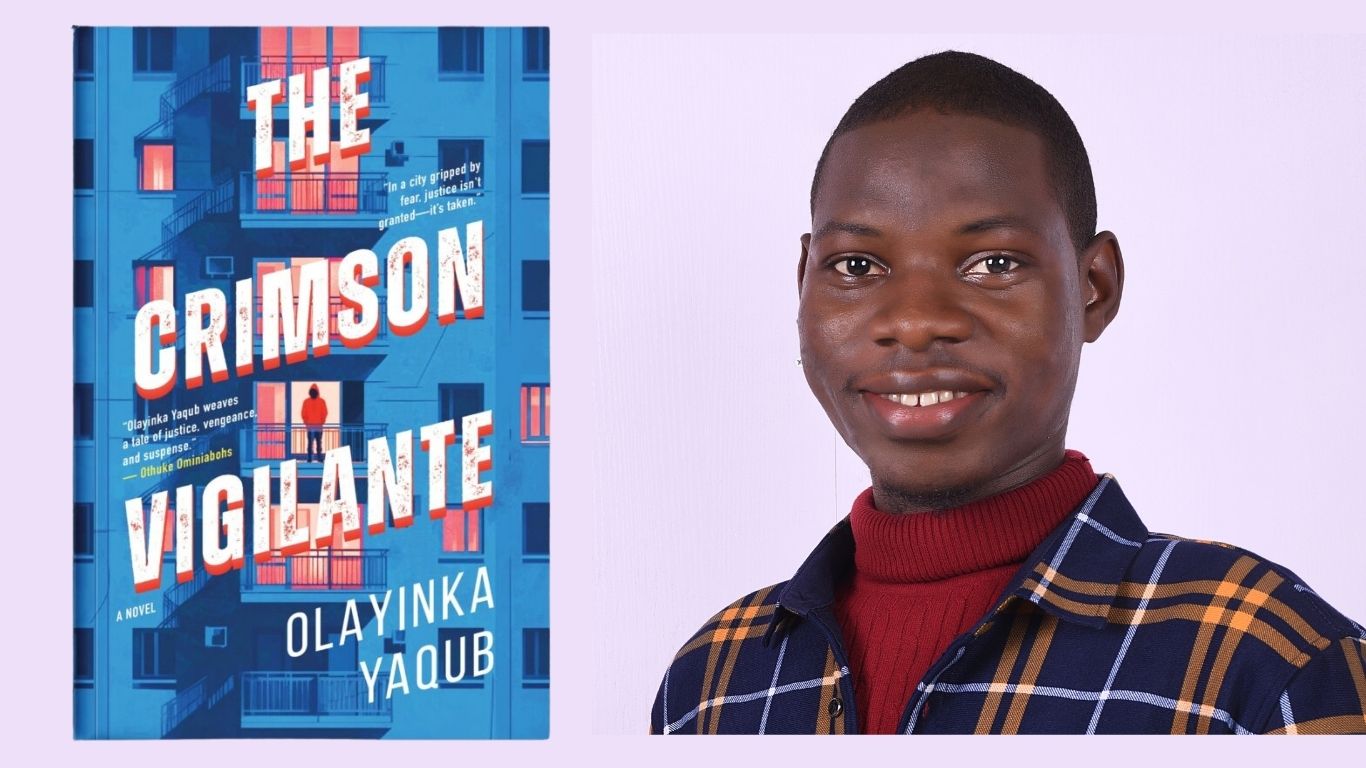
That boy was Olayinka Yaqub. He would go on to write not one novel but two before he turned twenty, query more than a hundred agents and publishers across both, collect dozens of rejections, and eventually sign a book deal with one of Nigeria’s leading trade publishers a few weeks before his twentieth birthday.
He answered the question of whether Nigerian crime fiction could exist on its own terms in a novel called The Crimson Vigilante. And he wrote almost the entire thing on his phone.
Who He Is
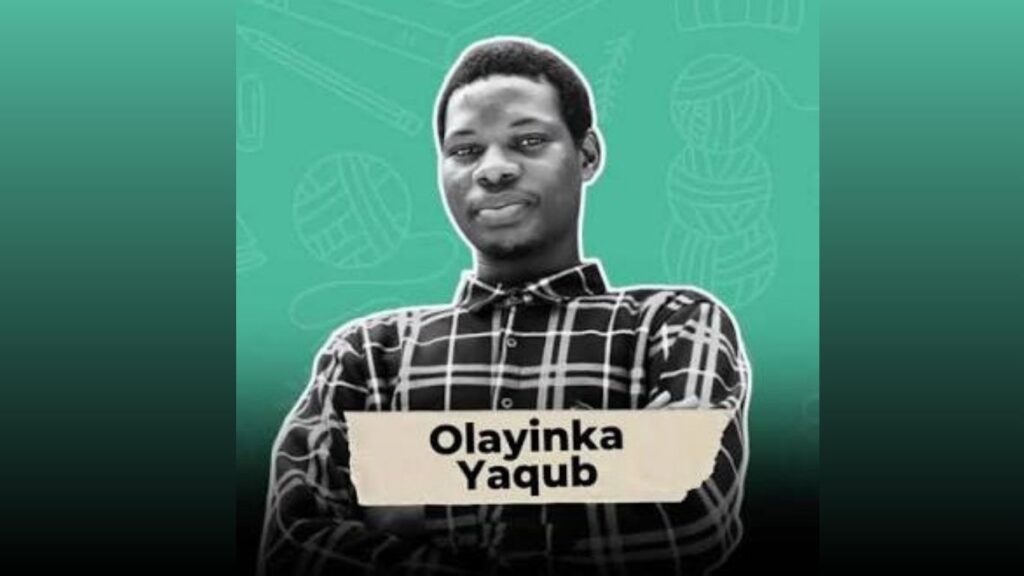
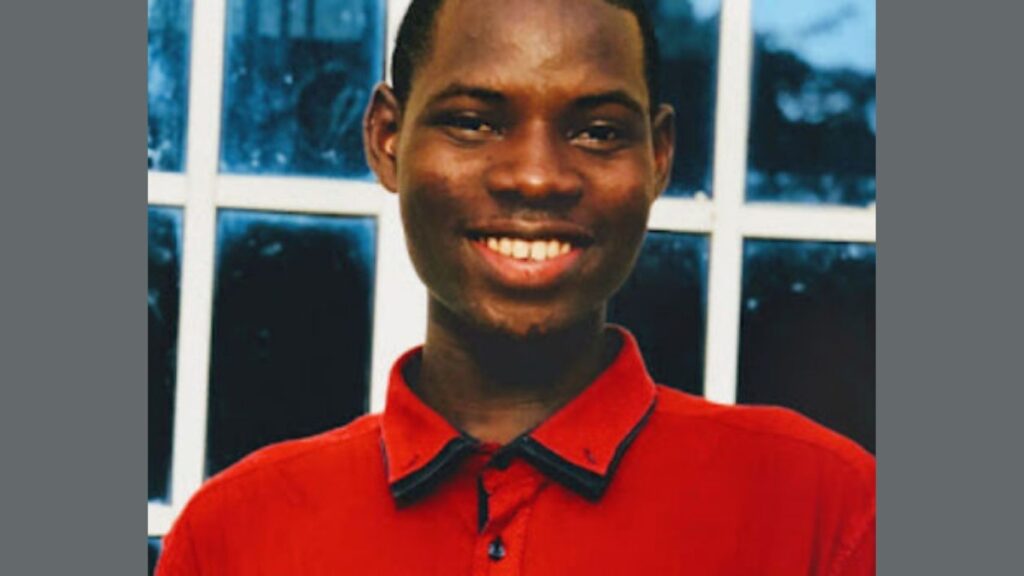
Olayinka Yaqub is a Lagos-based Nigerian writer currently studying chemical engineering at the University of Lagos. By his own account, his journey into storytelling began unusually early and in an unusual way. As a ten-year-old growing up in a face-me-I-face-you apartment block in Lagos, he took it upon himself to tutor the children around him, and when he found he had no teaching materials, he made his own: he disguised old notebooks as textbooks, hand-titling them things like “Mastering English by Olayinka Yaqub,” filling the pages with comprehension passages and exercises he invented himself.
He wrote his first story in 2014, at age eleven, after a single afternoon spent reading a contemporary boarding-school drama his older brother had been assigned for exams. The book was unlike anything he had read before, and it pushed him to write his own version, a clichéd but proudly completed forty-page notebook novel that he taped shut, had a classmate illustrate, and forced everyone around him to read.
By 2018, he had drifted from fanfiction communities into a more serious online writing group, where, surrounded by adults discussing story structure and character archetypes, he began to treat writing as a craft rather than a pastime.
In 2019, at sixteen, he began his first novel, The Bride in Black, during Camp NaNoWriMo, finishing a raw 50,000-word draft within a month before spending nearly a year rewriting it. He went on to query the manuscript with between thirty and thirty-five literary agents, receiving two full manuscript requests and twenty-four rejections before eventually shelving the project.
He did not stay discouraged for long. While sitting his final secondary school exams, a new idea — a revenge-driven, modern-day Robin Hood story set in Lagos — had already taken hold of him, and it excited him so much that he privately hoped his first book would not end up being his debut.
Before The Crimson Vigilante found a home, Yaqub had already begun building a track record in Nigeria’s literary competition circuit. In 2021, he won the Sandra Whiteley Prize for Children’s Literature, and in 2023 he took the Awele Creative Trust Award for his short story “The Weight of Duty.” His work has also been shortlisted for the Sevhage K&L Prize for Fiction and the HNM Prize for African Storytelling. More recently, in 2025 his short story “The Grand Funeral of Baba Alamu” won the JAY Lit Prize for Fiction, with judge Eugen Bacon praising how the story confronts loss, rivalry, jealousy and unrequited love through a darkly humorous twist of fate.
“A lot of people ask me how I balance writing with schooling, and the truth is… I’m still trying to figure out the balance myself.”
— Olayinka Yaqub, in conversation with Diversely, Crafter
The Book
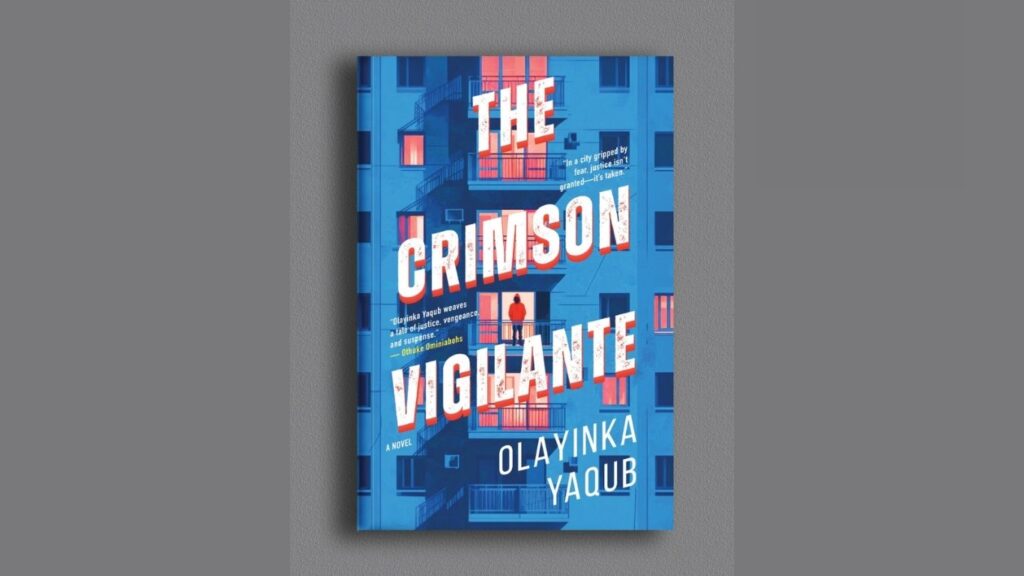
| Title | The Crimson Vigilante |
| Publisher | Masobe Books |
| Genre | Crime Thriller, Police Procedural |
| Setting | Lagos, Nigeria |
| Available | Masobe Books and major bookstores |
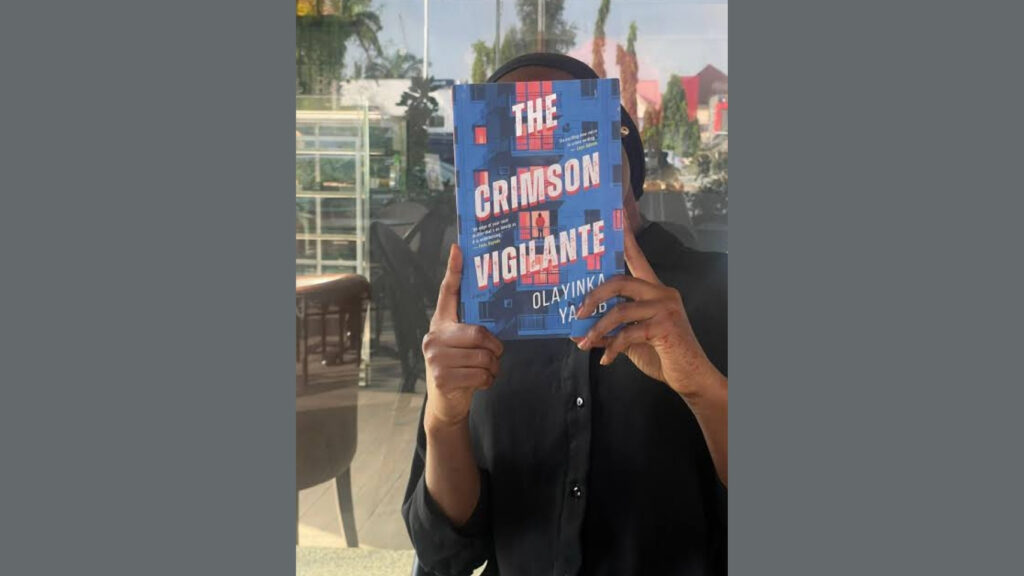
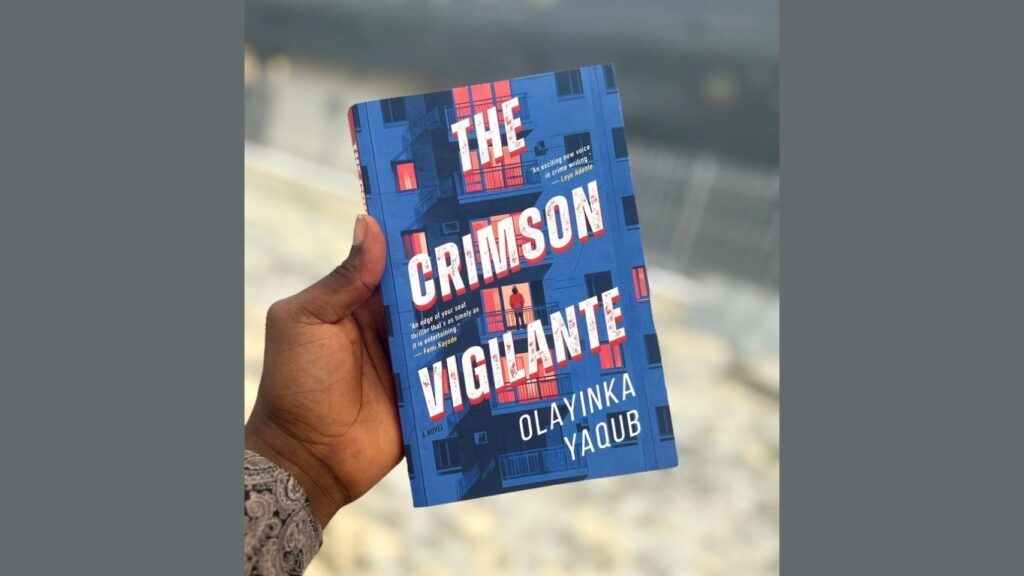
The Crimson Vigilante is a crime thriller with police-procedural elements, following Tomiwa Solade, an officer of the Nigerian Police Force, as he and his team hunt for a serial killer targeting Lagos’s elite. Rather than being feared, the killer becomes a folk hero to ordinary Lagosians, who give the mysterious figure the name that becomes the book’s title: The Crimson Vigilante. In Yaqub’s own description, the novel follows two detectives working together to track down a corruption fighter in Lagos who takes from the rich to give to the poor, and then disposes of his targets’ bodies along with letters detailing their corrupt deeds.
Readers have noted that the novel does not stay on the surface of its chase plot. Beneath the suspense, action, and moral complexity, it explores themes of child trauma, friendship, and family dynamics, and does not shy away from harsher realities: corruption, the exploitation of the poor by the wealthy, and the helplessness of ordinary people caught between a broken system and a vigilante driven by his own ego.
Yaqub credits Nigerian crime writer Leye Adenle as the biggest influence behind The Crimson Vigilante, describing Easy Motion Tourist as the novel that convinced him crime fiction could thrive in a distinctly Nigerian setting. He explains that years of reading international thrillers and watching crime television shaped his fascination with detective stories, but it was Adenle’s work that inspired him to tell those stories through a local lens. For Yaqub, the novel is both a tribute to the genre and an attempt to expand its possibilities within contemporary Nigerian literature.
“My writing process? A lot of winging it and hoping for the best.”
— Olayinka Yaqub, on writing one of Nigeria’s earliest Robin Hood–style crime novels
The Writing Journey
Here is a detail that matters more than it might first appear. Olayinka Yaqub wrote much of The Crimson Vigilante on his phone, a habit that made it possible for him to write almost anywhere, whether in transit, on a sidewalk, or in Lagos traffic. That flexibility became central to his writing process.
He began the novel in October 2020, immediately after shelving his first book, and spent a full year writing it, completing a manuscript of over 110,000 words just as he packed his bags for university in November 2021. As a first-year chemical engineering student juggling lectures and weekend tutorials, he could only return to the manuscript late at night, yet he still managed to cut the book down to roughly 104,000 words in preparation for querying.
The querying process tested him in ways the writing never had. He sent his first batch of queries for The Crimson Vigilante in February 2022 and received a full manuscript request within two days, only for it to come back as a rejection a week later — a pattern he came to call his personal Curse of the First Query. The rejections kept coming through a period when Nigerian university staff were on an eight-month strike, his family had relocated to another state, and he was living largely alone, scrolling through rejection emails that did not stop arriving. In total, he sent seventy-three queries for the novel, drawing fifty-three rejections, sixteen closed submissions with no reply, and only four full requests, before a single offer finally arrived.
The breakthrough came in March 2023, almost exactly a year after he began querying, when an agent passed his submission along to a colleague who wanted to read the full manuscript, and Masobe Books, which had been sitting on his submission from an earlier open call, reached out the same week asking to see more. The agent ultimately passed, deciding the book was too noir for their list, but Masobe did not. Yaqub signed his contract in September 2023, just weeks before his twentieth birthday.
“It took me a year to write The Crimson Vigilante in 2020, but I’ve been rewriting the book since 2021… Even when I got my book deal in 2023, I kept rewriting it.”
— Olayinka Yaqub
The Wit
What makes Olayinka Yaqub exceptional as a young writer is not simply that he has chosen an underexplored genre. It is that he chose to build, almost from scratch, an entire crime-fiction grammar for a Nigerian setting that did not yet have many of its own conventions to lean on. Where an established genre offers a writer scaffolding, Yaqub had to build the scaffolding himself, deciding what a Lagos rooftop fight scene looks like, what a midnight car chase across the Third Mainland Bridge sounds like, what a Nigerian vigilante’s moral logic should be, all without the comfort of a long shelf of comparable books to study.
He has also been unusually candid about a craft principle that separates serious writers from hopeful ones: that writing a book and publishing one are entirely different disciplines, and that a writer’s real test comes after the first draft, in the relentless cycle of revision. He has said plainly that what many new writers fail to understand is that every act of writing a book is really an act of rewriting it, again and again, sometimes even after a publishing contract is signed.
His process is instructive precisely because it resists the myth of the disciplined writer with a strict schedule. By his own admission, he is not a planner. He works from a loose mental map of where a story is going without always knowing how it gets there, editing each chapter until it satisfies him before he allows himself to move to the next, fitting his writing into whatever hours school leaves him, most often late at night.
That same instinct for revision shows up in his short fiction, where his prizewinning work, including the JAY Lit Prize-winning “The Grand Funeral of Baba Alamu,” has been recognised for blending grief and dark humour inside tightly compressed, second-person narration, a much harder discipline, he admits, than the expansive space a novel allows.
“I think what a lot of aspiring writers might not know is that writing is rewriting.”
— Olayinka Yaqub, in Author Interview with Medium
What He Teaches Us
If you have a manuscript sitting somewhere, on your phone, in a notebook, in a folder you open and close without adding to it, here is what Olayinka Yaqub teaches you. He wrote an entire crime novel on his phone, between lectures and tutorials, with no dedicated writing schedule and no perfect conditions. He simply found whatever hours the day left him.
He teaches you that rejection is data, not a verdict. He sent over a hundred queries across two books and faced dozens of nos, including the particular cruelty of full requests that ended in rejection, more than once. He kept going anyway, and he has been honest that the hardest part of publishing was never the writing itself but learning to be patient and to persevere through the silence.
He teaches you that being early to a genre is not a disadvantage, even when it is frightening. He has openly admitted to the nervousness of being among the first to write Robin Hood–style crime fiction in a Nigerian setting, of being, in his words, the test-run rather than following one. He wrote it anyway.
He teaches you, most importantly, that your age and your schedule are not the reasons you cannot write. He started his first full novel manuscript at sixteen. He signed his first book deal weeks before turning twenty, while still a university student with exams to study for.
The only question that matters is not how much time you have. It is whether you are still writing.
The Invitation
There is a book inside you that only you can write. Olayinka Yaqub wrote his on a phone screen, between engineering tutorials, through an eight-month university strike, through more than a hundred rejections across two manuscripts. He wrote it without certainty. He wrote it in spite of the nos. He wrote it because the story would not leave him alone.
Your story is waiting. Your readers are waiting. Your published book is waiting to exist in the world. You do not need perfect conditions. You do not need to wait until you feel ready. You need to begin, and then to keep going.
When you are ready to take your manuscript from idea to published, ACEworld is here. We help Nigerian authors bring their books into the world, professionally, globally, and with the care that every story deserves.
The Literary Spotlight is a weekly editorial column on the ACEworld Blog celebrating the authors shaping the future of African literature. To nominate an author for a future edition, contact us.
