
Mustapha Enesi: The Quiet Force Reimagining Contemporary African Fiction
Picture this. Somewhere in Ilorin, a young university student closes his textbooks after another demanding day of studying Agriculture. The equations, laboratory reports, and lectures have earned him a reputation as one of the brightest minds in his class. Yet when the day’s academic work is over, another discipline quietly takes over. He opens a different notebook, one untouched by scientific formulas, and begins writing about people instead.
Not heroes. Not celebrities. Just ordinary people carrying extraordinary burdens.
A woman wrestling with expectations she never chose. A family weighed down by unspoken grief. A child trying to make sense of silence. A memory that refuses to loosen its grip. These are the lives that capture his imagination, not because they are spectacular, but because they are recognisable. They echo the quiet conflicts unfolding behind countless closed doors across Nigeria and beyond.
There are no literary prizes waiting for him then. No invitations to festivals. No reviews praising his prose. Only a growing conviction that stories can illuminate parts of human experience that facts and headlines often leave untouched. Years later, those stories would travel farther than he could have imagined. They would appear in respected literary journals, earn prestigious awards, and culminate in the publication of a debut collection that announced the arrival of one of Nigeria’s most compelling contemporary fiction writers. Readers would come to know his name not because he chased attention, but because his stories demanded it.
That writer is Mustapha Enesi.

Who He Is
Every literary generation produces writers less interested in entertaining the world than in helping it understand itself. Mustapha Enesi belongs firmly to this tradition. Born in Nigeria and of Ebira heritage, Enesi has emerged as one of the country’s most exciting contemporary fiction writers. Part of a new wave reshaping African literature, his work resists easy labels. He writes with restraint, trusting subtle details and emotional honesty to carry the weight of his stories—inviting readers to slow down, listen carefully, and discover meaning in the silences between words.
Literature was not the discipline that first defined his academic life. Enesi studied Agriculture at the University of Ilorin, graduating as the overall best student in his department. While science trained him to observe the natural world with precision, fiction offered an inquiry into the intricate landscapes of memory, identity, love, grief, and human relationships. Agriculture concerns itself with growth, seasons, and survival; Enesi’s fiction does the same, examining how people endure emotional droughts, adapt to loss, and search for belonging.
Before readers began celebrating his stories, Enesi built his career through quiet persistence, reading widely, revising patiently, and submitting to journals. His fiction has since appeared in respected international publications, including Transition Magazine, The Republic, Isele Magazine, Litro Magazine, and The Maine Review.³ These platforms have expanded global understanding of African literary traditions, and Enesi’s presence among them signals the growing international reach of his perspective.
What distinguishes Enesi is his commitment to emotional authenticity over dramatic twists or elaborate plots. His stories unfold with quiet confidence, turning family conversations into explorations of generational trauma and ordinary domestic moments into meditations on survival. His characters—mothers, fathers, lovers, and neighbours—are not extraordinary in a conventional sense, yet Enesi reveals the immense emotional complexity hidden within everyday lives.
This sensitivity to overlooked experiences makes him especially adept at writing female characters with empathy and nuance. Rather than reducing women to symbols or stereotypes, he presents them as complete individuals navigating difficult choices, private disappointments, and personal aspirations. Critics and readers frequently highlight this capacity for compassionate observation as one of his greatest strengths.
Beyond awards and recognition, Enesi’s true significance lies in how he expands the possibilities of African fiction. He belongs to a movement of contemporary writers refusing simplistic narratives about the continent, choosing instead to embrace complexity, tenderness, and ambiguity. His work is deeply Nigerian in its cultural texture, yet profoundly universal in its reach.
For readers encountering his work, Enesi balances specific cultural context with questions that belong to everyone: How do we carry grief? How do we reconcile who we were with who we have become? What does it truly mean to be seen? These questions define his fiction and ensure his stories linger long after the final page.
“Never edit your story to fit into narratives that are not authentic to your roots.”
— Mustapha Enesi, in conversation with The African Authors Podcast
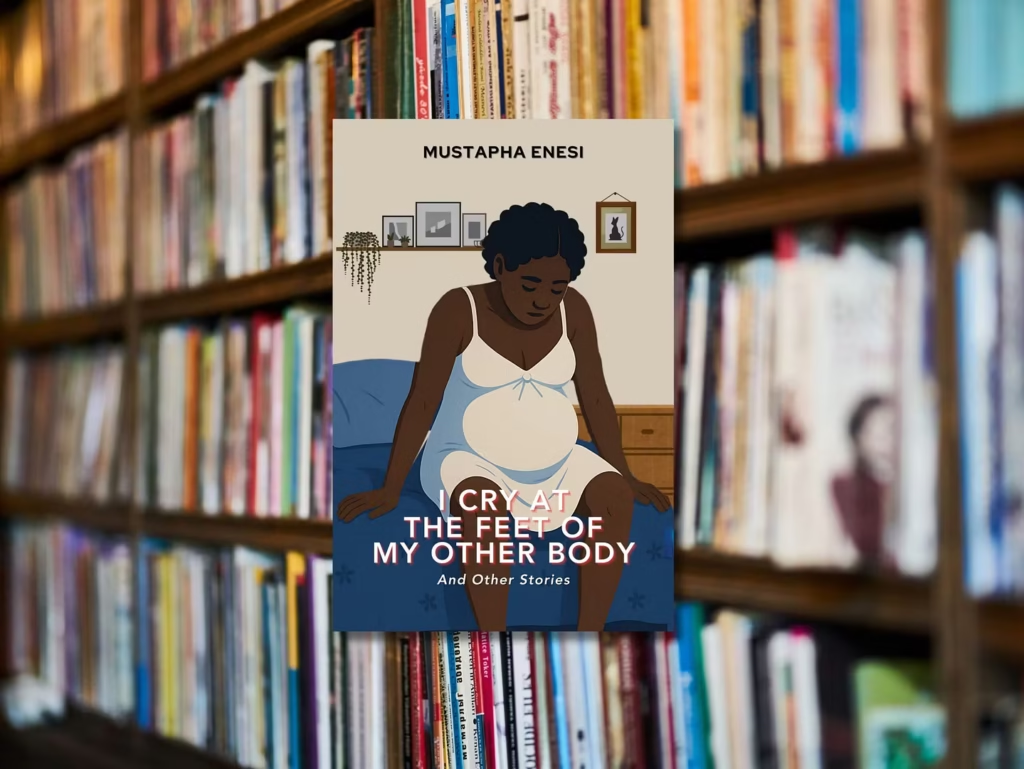
The Book
| Title | I Cry at the Feet of My Other Body and Other Stories |
| Format | Debut short story collection |
| Genre | Literary Fiction / Short Stories |
| Publisher/Platform | Witsprouts Books |
| Themes | Identity, grief, womanhood, motherhood, memory, family, love, loss, belonging, resilience |
| Available | Witsprouts Books and major online booksellers |
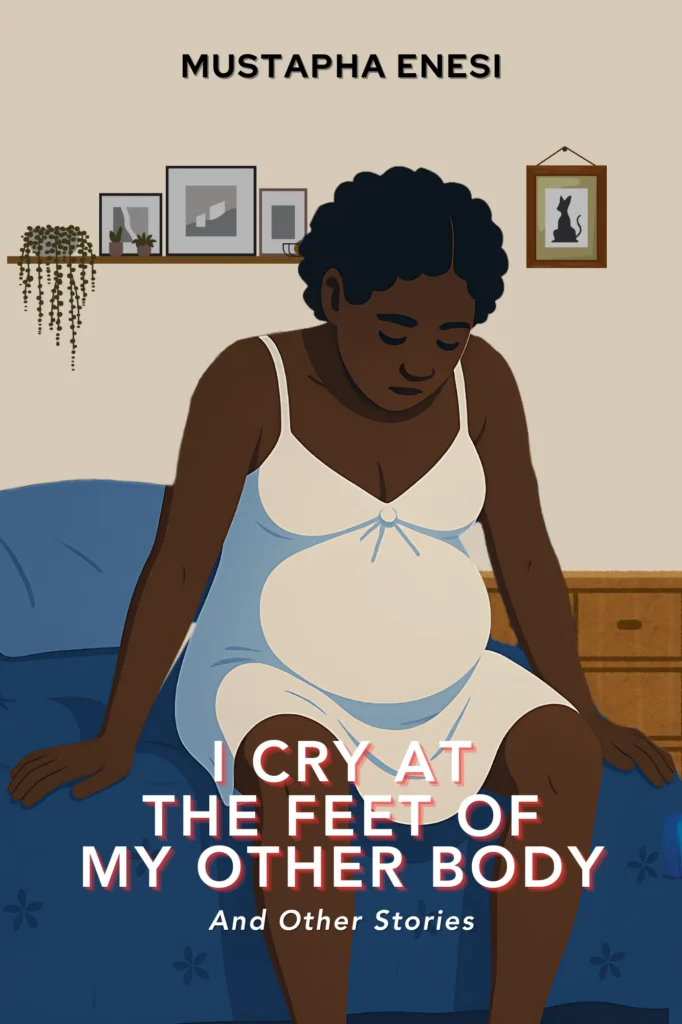
Every writer has a moment when years of quiet labour crystallise into a single work that introduces them to a wider audience. For Mustapha Enesi, that moment arrived with the publication of I Cry at the Feet of My Other Body and Other Stories, his debut short story collection released by Witsprouts Books in September 2025.
The title itself suggests fragmentation, duality, and the complicated relationship between who we are and who we are expected to become. It prepares readers for stories that resist simple interpretations, announcing a writer interested in emotional complexity rather than convenient resolutions.
Across the collection, Enesi explores identity, grief, womanhood, memory, motherhood, loneliness, love, and survival. Yet these themes are always embodied in people navigating recognisable circumstances: daughters carrying family expectations, women negotiating societal pressures, and families living with loss.
One of the collection’s greatest strengths is its emotional restraint. Rather than relying on dramatic revelations, Enesi’s stories unfold patiently. A quiet conversation becomes an act of resistance; a familiar object becomes a repository of memory. This confidence trusts readers to notice what is not loudly announced.
Although many stories centre on women, Enesi writes his characters as fully realised individuals whose hopes, fears, contradictions, and resilience coexist naturally. His empathetic approach has drawn praise for listening to women’s emotional realities and acknowledging structural inequalities without sacrificing individuality.
The collection also reflects a broader shift in contemporary African literature away from conflict-driven narratives toward intimacy, interiority, and everyday existence. Enesi’s stories are unmistakably Nigerian in setting, language, and cultural references, yet they remain universally accessible. They ask fundamental human questions about inheritance, grief, love, and memory that resonate whether read in Lagos, London, or New York.
Enesi’s prose is measured, precise, and quietly musical, illuminating character without overshadowing it. I Cry at the Feet of My Other Body and Other Stories confirms the promise of Enesi’s earlier short fiction while introducing a writer whose vision is deeply assured.
For emerging writers, the debut shows that a book does not need to announce itself with noise—it needs clarity of purpose. Enesi’s collection preserves memory, creates empathy, and reminds us that behind every ordinary life lies a world worthy of literature. It announces a literary voice likely to shape conversations about Nigerian fiction for years to come.
“The body remembers more than we like to admit.”
— Mustapha Enesi, from his published essay, An Anatomy of a Falling Body

The Writing Journey
Long before readers searched for his name in bookstores or festivals invited him to speak, Mustapha Enesi was doing what nearly every great writer does before recognition arrives: writing in obscurity.
Behind every published story lies another that never saw the light of day—countless hours spent revising sentences, responding to editorial feedback, and submitting manuscripts with no guarantee of acceptance. For Enesi, the journey to recognition was shaped by quiet consistency and an unwavering commitment to improving his craft one story at a time.
Like many contemporary African writers, Enesi’s earliest audience was literary journals. These publications serve as testing grounds where emerging voices develop confidence and refine their style. Over time, his work appeared in respected outlets including Transition Magazine, The Republic, Isele Magazine, Litro Magazine, and The Maine Review. Within the literary world, these credits represent spaces known for publishing writers with originality and technical skill. Each acceptance sharpened his voice, providing another opportunity to understand what his fiction could achieve.
Unlike careers propelled by viral moments, Enesi’s evolution was gradual, reflecting the confidence of someone allowing experience and careful observation to mature naturally. That commitment soon earned formal recognition.
In 2021, his short story “Kesandu” won the K & L Prize for African Literature, an award recognizing exceptional unpublished fiction by emerging African writers. “Kesandu” demonstrated his ability to transform intimate human experiences into narratives with universal emotional resonance, inviting readers into carefully observed worlds where small gestures carry deep meaning. That same year, his story “Safety Pins Are Good Omens” won the Awele Creative Trust Award, cementing his reputation as one of African literature’s most promising young voices. Receiving two major honours in a single year signalled a body of work distinguished by consistency and emotional intelligence.
Enesi’s path reflects a broader evolution within African publishing. Where writers once depended heavily on a few international publishers, a growing ecosystem of African literary magazines, independent publishers, and creative prizes now creates new pathways for emerging voices. Institutions like The Republic, Isele, the K & L Prize, and the Awele Creative Trust nurture talent long before it reaches mainstream audiences. Enesi’s career illustrates the importance of these institutions in nurturing literary excellence across the continent.
The publication of his collection, I Cry at the Feet of My Other Body and Other Stories (2025), represented the culmination of years spent building a reputation one story at a time. The book simply invited the wider world into a conversation that had been unfolding for years.
Enesi’s journey reminds aspiring writers that literary success is rarely overnight; it is the product of sustained faith in the craft, continuous learning, and the courage to keep writing long before the applause begins.

The Wit
There is a quiet confidence that runs through Mustapha Enesi’s writing. It is not the wit of sharp punchlines or flamboyant prose. It is the kind that notices what others miss.
Enesi understands that the most profound conflicts are often the ones that unfold in silence. A pause during a family conversation. A memory that refuses to fade. A decision made out of love but remembered with regret. These seemingly ordinary moments become the emotional centre of his stories, revealing how deeply he observes the human condition.
His fiction is marked by restraint. Rather than telling readers what to think or feel, he allows scenes to breathe, trusting them to arrive at their own emotional conclusions. This confidence in subtle storytelling is one of the qualities that sets his work apart. It reflects a writer who understands that the quietest moments often leave the deepest impressions.
Another hallmark of Enesi’s wit is his ability to write with empathy. His characters are never reduced to simple heroes or villains. Instead, they are presented as complex individuals shaped by memory, culture, love, fear, and circumstance. Whether writing about women navigating societal expectations or families carrying invisible burdens, he approaches each character with compassion rather than judgement.
There is also an unmistakable poetic quality to his storytelling. Even the title of his debut collection, I Cry at the Feet of My Other Body and Other Stories, hints at a writer drawn to metaphor, layered meanings, and emotional ambiguity. His prose invites readers to linger, reflect, and uncover significance beyond the surface of the narrative.
Ultimately, Enesi’s greatest wit lies in his attentiveness. He reminds us that extraordinary stories do not always emerge from extraordinary events. More often, they are hidden within ordinary lives, waiting for a writer patient enough to notice them.
That ability to transform everyday experiences into deeply affecting literature is what makes Mustapha Enesi one of the most compelling voices of his generation.
What He Teaches Us
Not every writer teaches through lectures or workshops; some instruct simply through how they live and the stories they tell. Mustapha Enesi belongs to this latter tradition, offering a clear guide for emerging creatives through his work and dedication.
Your Voice Is Your Greatest Advantage: Enesi resists noisy trends, favoring quiet introspection over superficial spectacle. Originality is not about being different for its own sake, but about telling the stories only you can tell. Readers rarely search for the loudest voice in the room; they search for the truest one.
Excellence Attracts Recognition: behind accolades like the K & L Prize for African Literature lie years of patient reading, drafting, and continuous revision. Visibility and instant gratification cannot substitute for continuous effort. Recognition is simply the byproduct of long-cultivated excellence.
Pay Attention to People: Enesi’s fiction centers on human subtlety—a mother’s silence, a neighbor’s loneliness, or unspoken grief. Great storytelling begins with careful observation. The more closely we observe others, the deeper our empathy and understanding become.
Write with Empathy, Not Judgment: resisting simple binaries of heroes and villains, Enesi presents complex characters shaped by real flaws and contradictions. Literature gains lasting power when it prioritizes understanding over rapid condemnation.
Patience and Purpose: from quiet drafts to final publication, meaningful growth cannot be rushed. Literature serves as an act of witness to preserve lives and emotions that might otherwise be overlooked. Writers should not craft work merely to be noticed, but to notice the world around them.
The Invitation
Every celebrated author was once an unpublished writer with a manuscript, a dream, and a choice to make.
Mustapha Enesi’s journey reminds us that literary success does not begin with awards, bestseller lists, or widespread recognition. It begins with the courage to write, the discipline to keep refining your craft, and the willingness to let your stories find the readers they were written for.
Today, his work is read, celebrated, and studied because he chose not to let his stories remain unfinished or unseen. He believed in his voice enough to share it with the world, one story at a time. In doing so, he transformed quiet moments of creativity into a body of work that continues to resonate with readers in Nigeria and beyond.
Perhaps your story is waiting for the same opportunity.
The manuscript you’ve been postponing could become the book that inspires, comforts, or changes someone’s life. But no story can make an impact until it is given the chance to be read.
When you’re ready to take your manuscript from idea to publication, ACEworld Publishers is here to guide you every step of the way. From manuscript development to professional publishing and global distribution, we help authors transform their stories into books that are ready to meet the world.
Because every published book begins with a writer who decides that their story deserves to be told.
The Literary Spotlight is a weekly editorial column on the ACEworld Blog celebrating the authors shaping the future of African literature. To nominate an author for a future edition, contact us.