The Boy from Ibadan Who Wept on a Plane, Lost the Poem, and Found It Again in the Snow
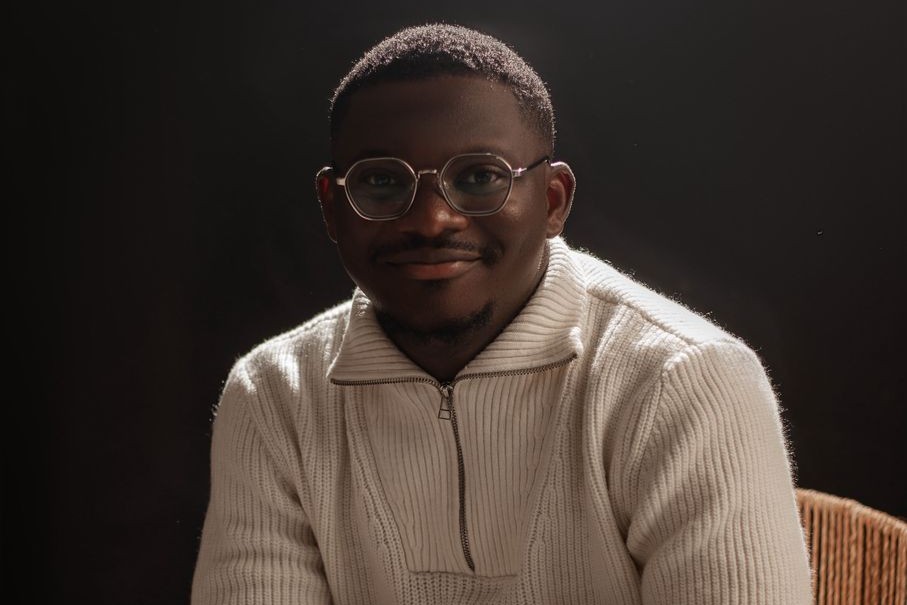
Picture this. A young Nigerian man boards a flight for the first time, heading from Nigeria to the United States. He is en route to the Iowa Writers’ Workshop — one of the most prestigious creative writing programmes in the world — and somewhere over the Atlantic, the city he grew up in rushes back to him so violently and so completely that he begins to weep. The Nigerian woman seated beside him offers her handkerchief. She sees he is writing through his tears and asks if he writes songs. He says yes.
He lands at O’Hare Airport and realises the poem is gone. He sits outside the men’s toilet in the terminal, crying, waiting for his connecting flight to New Jersey. The poem does not return to him until his first night in Iowa — a night he describes as oddly chilly and incredibly lonely — and when it does, it becomes the opening of a debut collection that a decade of working poets, editors, and fellowships had been waiting for.
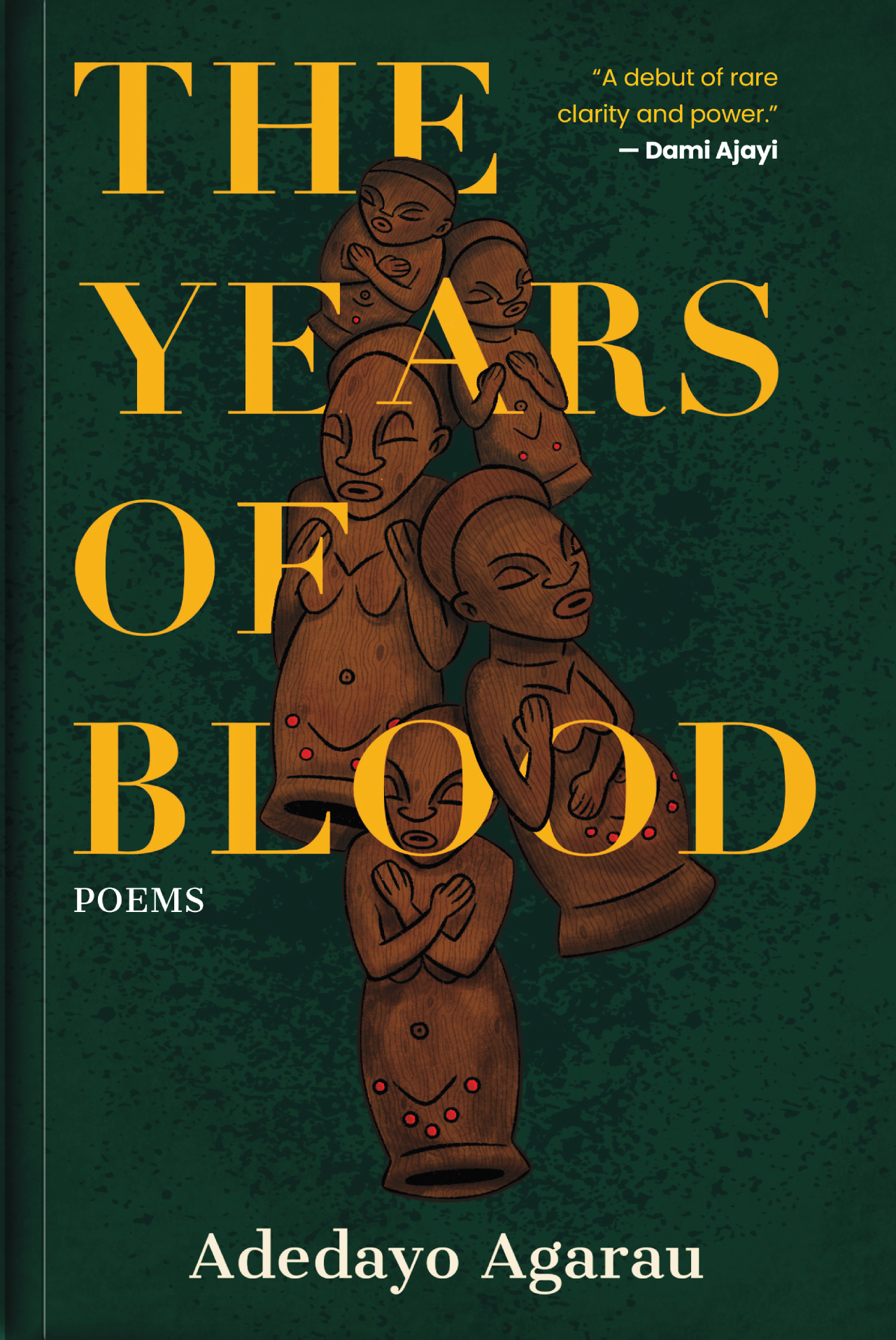
That poem was “Ibadan.” That collection is The Years of Blood. Adedayo Agarau was thirty-one years old when Fordham University Press published it in September 2025. And the world had no choice but to listen.
Who He Is
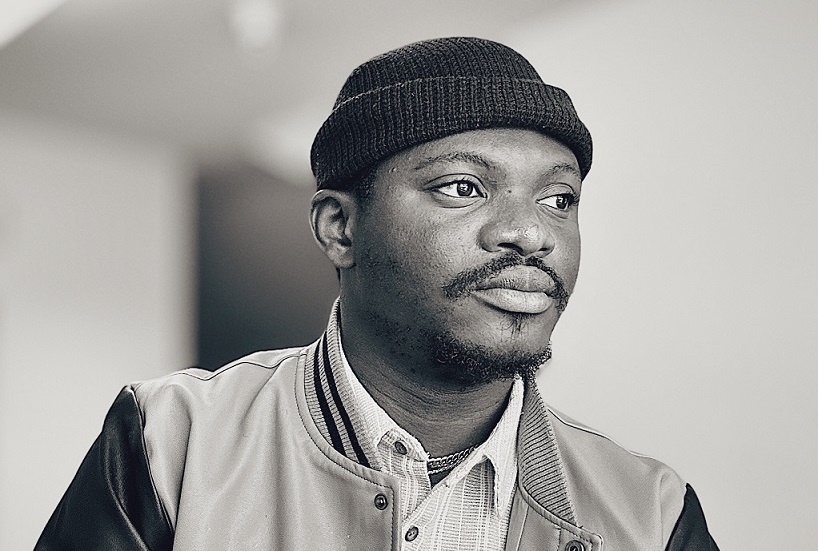
Adedayo Adeyemi Agarau was born in 1994 in Ibadan, Nigeria — the southwestern city that would become both the landscape and the wound at the centre of his most important work. He attended Bodma International School Ibadan, Ibadan Boys High School, and Scores College, Ibadan, before going on to study Human Nutrition and Dietetics, earning a National Diploma from The Federal Polytechnic, Ede, and a Higher National Diploma from Rufus Giwa Polytechnic, Owo.
He is also a documentary photographer. And a poet — the kind of poet who, even before a single fellowship or international prize had noticed him, was standing at spoken word events in Ibadan in 2015 making audiences snap their fingers, get out of their seats, and whistle, while others watched in quiet admiration.
His CV, by the time of his debut’s publication, was staggering. He holds an MFA in Poetry from the Iowa Writers’ Workshop (2023), where he was recognised with the Stanley Award for International Research. He served as a Wallace Stegner Fellow at Stanford University from 2023 to 2025 — one of the most coveted fellowships in American poetry. He is a Cave Canem Fellow. He was a 2024 Ruth Lilly and Dorothy Sargent Rosenberg Poetry Fellowship finalist. He is currently a PhD candidate in Creative Writing at the University of Southern California.
He is Editor-in-Chief of Agbowó Magazine, a journal dedicated to African literature and art, and serves as Poetry Reviews Editor at The Rumpus. His poems have appeared in Poetry Magazine, Guernica, World Literature Today, Iowa Review, and elsewhere. They have been exhibited at the Wellcome Collection of Medicine in London and at the Paris Photo Exhibition. He has taught at Stanford University, the University of Iowa, and various programmes in Nigeria.
He is also a builder of communities. He is a member of the UnSerious Collective Fellowship, which supports emerging Nigerian writers. He is a founding editor of Poetry Sango-Ota, which organises poetry workshops and mentoring opportunities for young Nigerian poets. He founded the Arole Agarawu International Poetry Prize for African Writers. He curated and edited Memento: An Anthology of Contemporary Nigerian Poetry — the largest poetry anthology by Nigerian poets.
His awards include the Future Awards Africa Prize for Literature (2025), the C.P. Cavafy Poetry Prize (2024) for his poem “Halloween, Iowa,” the Poetic Justice Institute Editor’s Prize for BIPOC Writers (2023–24), and the Eriata Oribhabor Poetry Prize runner-up (2017), among others. He was shortlisted for the 2024 Wales International Poetry Prize and the 2022 Brunel Poetry Prize, and was a finalist for the 2023 Sillerman First Book Prize.
“Here was a poet who had something to say, and who would do everything to make sure the world listened. It’s 2025 now, and he’s still making the world listen.”
— KÁNYIN Olorunnisola, Chicago Review of Books
The Book
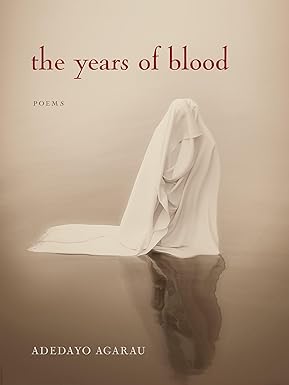
| Title | The Years of Blood |
| Author | Adedayo Agarau |
| Publisher | Fordham University Press |
| Year | 2025 |
| Genre | Poetry / Debut Collection |
| Awards | 2026 Nossrat Yassini Poetry Prize, 2023–24 Poetic Justice Institute Editors Prize for a BIPOC Writer |
| Also recognised | 2026 Nigeria Prize for Literature (Longlisted), 2024 Wales International Poetry Prize (Shortlisted), 2023 Sillerman First Book Prize (Shortlisted), 2022 Brunel Poetry Prize (Shortlisted), Named one of the 25 best poetry books of 2026 by the New York Public Library. |
The Years of Blood confronts one of the most harrowing and under-examined realities of contemporary Nigerian life: the ritual killings and child abductions that have terrorised the streets of Ibadan from the turbulent pre-democratic era to the present day. These crimes — driven by economic desperation, religious extremism, and societal dysfunction — have claimed countless lives and left entire communities living in a state of numbed, recursive fear. Agarau grew up inside that fear. He watched it. He survived proximity to it. And then he wrote it.
The collection is set against the specific geography of Ibadan — from the militaristic air of Òkè-adó to the deathly streets of Sókà — and its poems move through dreamlike landscapes and surreal imagery that resist rational explanation, because the events they document resist rational explanation. Memory, in this book, is as vital as it is ungraspable: as the poem “the abduction” puts it, memory forsakes the body at the point where fear fills the body like air.
The poems are structured as witness — but not the traditional, external witness of documentary poetics. Agarau has spoken directly about his rejection of a stance that positions the poet as an outside observer of suffering. When you are both witness and witnessed, when the story is happening to you, through you, around you, in the very community that raised you, the conventional witness poem fails. So he witnessed as the self, with the poet standing as the consciousness of the collective.
Yoruba cosmology and language are woven throughout. Agarau has explained that code-switching is simply how thought moves for a multilingual person — that sometimes only Yoruba carries the precise emotional register of a memory. The collection includes a five-page glossary not as an apology, but as what he calls an act of hospitality and an act of resistance: a refusal to edit his wholeness for any reader’s comfort, while providing the tools for readers to meet him where he is.
World Literature Today described the collection as “a necessary book, one that understands poetry as an obligation,” noting that the poems stage kidnappings, ritual killings, and sudden disappearances as lived experiences, and that they stand out for their emotional precision and resistance to narrative closure.
TriQuarterly described the collection as invoking dreamscapes with oneiric lyricism to meditate on communal loss and grieving, contending with the costs of inheritance including the afterlives of ritual violence, in a series of elegiac poems whose ululations echo beyond the borders of the page.
The Compulsive Reader, citing Agarau’s own words from a 2025 interview, placed the collection alongside Marquez’s magical realism: what the West considers speculative is everyday African life.
“The poem becomes a threshold, a crossroad where the living and the departed can meet. In Yoruba cosmology, the boundary between the living and the ancestors is porous. The dead don’t disappear — they transform.”
— Adedayo Agarau, in conversation with the Chicago Review of Books
The Writing Journey
Adedayo Agarau published his first chapbook, For Boys Who Went, in 2016 — as a self-published work through Authorpedia. He was around twenty-two years old, and already writing about the boys who disappeared from the streets of Ibadan, although, as he has reflected, the book had not yet fully figured out how to achieve the unbecoming, that loss, that it was reaching for.
His second chapbook, The Arrival of Rain, was published by Vegetarian Alcoholic Press in 2020. His third, Origin of Name, was selected by Kwame Dawes and Chris Abani for the New-Generation African Poets: A Chapbook Box Set (African Poetry Book Fund/Akashic Books, 2020) — one of the most prestigious chapbook series on the African continent. He was also runner-up for the Sehvage Poetry Prize (2019) and shortlisted for the Babishai Niwe Poetry Prize (2018).
In 2021, he was a finalist for the Sillerman First Book Prize with an earlier version of what would become The Years of Blood, then titled The Morning the Birds Died. He received his MFA from the Iowa Writers’ Workshop in 2023. He then received the Wallace Stegner Fellowship at Stanford, and it was during this period of fellowships, workshops, and intentional craft-building across many years that The Years of Blood was fully realised.
The writing of the collection was not a clean process. The opening poem was lost at an airport. Many of the poems arrived in states of deep grief — Agarau has described sitting down in a snow pile on a street in Iowa City in October 2021 when memories returned to him, weeping at what had been taken from a generation of Nigerians and how little the world had said about it. An almost-final draft was shared with poet Remica Bingham-Risher, who told him: this book is loaded with grief, and there is no rest for even the poet. Her advice led to a final round of new poems — “Ileya,” “Boys Who Never Die,” “Prelude Christmas” — written specifically to give the poet, and the reader, somewhere to breathe.
The book was published by Fordham University Press on 2 September 2025. A couple who encountered Agarau at TruCoffee, having read the poem “Ghost of a Boy Writes from Soka,” held hands and wept.
His second full-length collection, The Morning the Birds Died — exploring the death of his paternal grandmother, mental health, dreams, and spirituality — is under contract and slated for 2027.
“Distance makes your relationship with home more honest. While the body leaves, the body stays… Distance, then, becomes translation. Not abandonment. Not escape.”
— Adedayo Agarau, in conversation with the Chicago Review of Books
The Wit
What makes Adedayo Agarau one of the most important Nigerian poets of his generation is not only his subject matter — though the subject matter is urgent and necessary. It is his absolute refusal to simplify. He has built, over more than a decade of chapbooks, fellowships, editorial work, and community-building, a poetics that can hold grief without resolving it, that can speak for the collective without erasing the personal, and that can use Yoruba cosmology and oral tradition not as decoration but as structural architecture.
His treatment of Yoruba in the collection is a perfect example. He does not use the language to signal authenticity. He uses it because, in his own words, sometimes only Yoruba carries the emotional weight he needs. To write ffiṣẹ as “so be it” would be to perform translation for an imagined reader whom he is not sure he wants to centre. He wrote instead for the full weight of the word — its cosmology, its spiritual authority, the breath of ancestors moving through it — and then offered the glossary not as surrender but as invitation.
His decision to reject the conventional witness stance in poetry is equally important. In traditional witness poetics, the poet stands outside the trauma and documents it. Agarau refuses that distance, because the distance is a lie. He was inside the trauma. He grew up inside it. The city that was killing boys was also his city, and the poet who wants to write truthfully about such a city must write as self, not as external correspondent. That choice produces poems of a different emotional texture — more raw, more implicating, more honest, than the documentary mode could ever achieve.
And then there is the community work, which in Agarau’s case is inseparable from the poetry. He edits Agbowó, mentors through Poetry Sango-Ota, curates the largest anthology of Nigerian poets, and founded a prize for African writers. These are not extracurricular activities. They are the expression of a poet who understands that African literature needs infrastructure as much as it needs individual brilliance, and who has decided to build both.
“African literature needs to be part of the global literary discourse, and I am glad that teachers, writers, and poets are turning their gaze to the critical poetry voices emerging from Africa right now.”
— Adedayo Agarau, in conversation with the Chicago Review of Books
What He Teaches Us
If you are a young Nigerian writer — in Ibadan, in Lagos, in Owerri, in a polytechnic hostel room — here is what Adedayo Agarau teaches you. He published his first chapbook at twenty-two, self-published, before any fellowship had noticed him. He built his reputation poem by poem, prize by prize, rejection by rejection, over nearly a decade before his full-length debut arrived. He did not rush it. He did not stop.
He teaches you that a degree in Human Nutrition does not disqualify you from becoming one of the most decorated Nigerian poets of your generation. The credential that matters is the poem itself, the discipline behind it, and the willingness to keep going through the years when no one important is watching.
He teaches you that community is not optional. He has built a magazine, a prize, an anthology, a mentorship programme, and a fellowship membership — not because he was required to, but because he understood that the infrastructure matters as much as the individual voice. A Nigerian poet working alone is weaker than a Nigerian literary community. He chose to build the community.
He teaches you that exile, distance, and displacement are not obstacles to writing about home. They are, in his own words, translation. The body that leaves is the same body that stayed. Distance makes the relationship with home more honest, not less. And it was sitting in the snow in Iowa — twelve thousand kilometres from Ibadan — that the memories finally had room to breathe.
He teaches you, most powerfully of all, that the stories Nigerian cities are trying to forget — the boys who went, the children taken, the blood in the streets that everyone learned to walk around — are exactly the stories that need to be written. And that writing them with full honesty, full Yoruba, full grief, and full self, is not performance. It is obligation.
The Invitation
There is a book inside you that only you can write. Adedayo Agarau wrote his on scraps of grief carried across an ocean, in snow piles in Iowa, in an airport terminal where the poem had been lost and not yet found again. He wrote it with Yoruba intact and the dead speaking through him and a city no one wanted to mourn finally demanding to be mourned.
He wrote it without certainty. He wrote it through years of chapbooks that were practice and through fellowships that were shelter and through the editorial work and prize-founding and anthology-curating that said: this literature matters, and I will prove it by building the infrastructure it deserves.
Your story is waiting. Your readers are waiting. Your published book is waiting to exist in the world. You do not need perfect conditions. You do not need to wait until you feel ready. You need to begin, and then to keep going.
When you are ready to take your manuscript from idea to published, ACEworld is here. We help Nigerian authors bring their books into the world, professionally, globally, and with the care that every story deserves.
The Literary Spotlight is a weekly editorial column on the ACEworld Blog celebrating the authors shaping the future of African literature.. To nominate an author for a future edition, contact us.