
The Poet Who Found Inspiration on a Horse Farm
Picture this. It is the winter of 2022. A young Black poet, her mind fractured by a period of deep personal turmoil, rents a small cottage on a horse farm in Wiltshire, England. She has no fixed plan. What she has is the advice of another poet ringing in her ear: push through, and make sure you get it all down. So, every morning, before her sense of time and logic have fully formed, before the noise of the world can reach her, she writes — not from craft, not from agenda, but from her dreams. From whatever is true before the performance of the day begins.
She spends a month doing this. Writing first thing every morning, fifteen minutes of raw, prelogical language, catching herself in what she later calls a preconscious state, producing the most radical and honest things she has ever written. When she returns to London, she assembles about a dozen poems from those sessions. Many of them end up in the book.
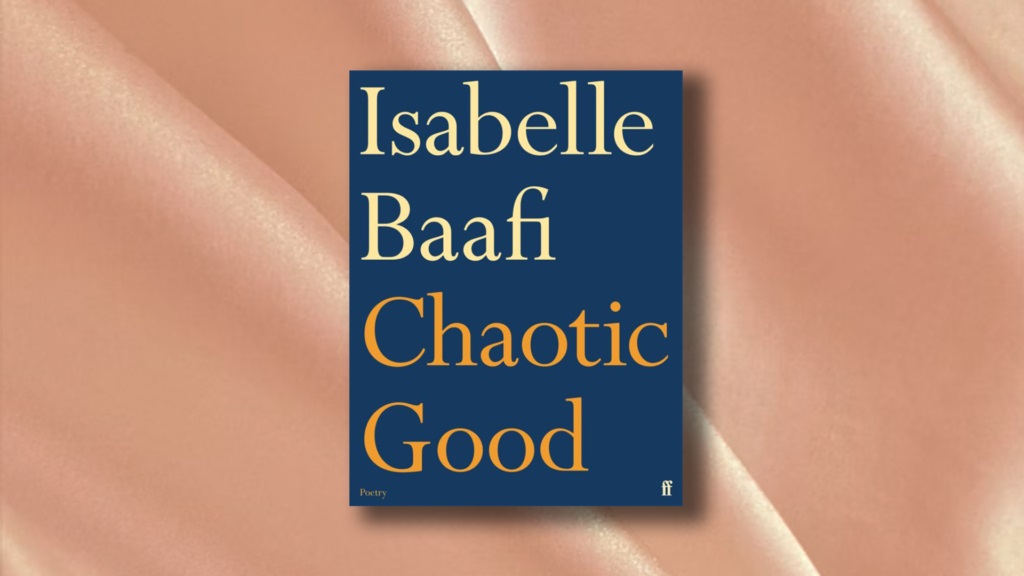
That book is called Chaotic Good. And in 2025, it won the Forward Prize for Best First Collection — one of the most prestigious poetry awards in the English-speaking world. Isabelle Baafi was in her mid-twenties.
Who She Is
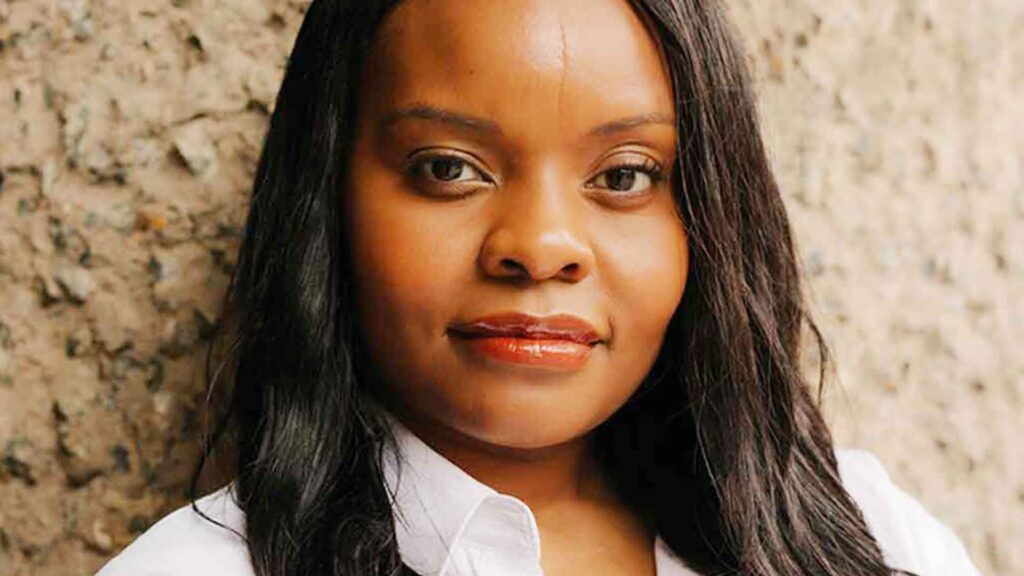
Isabelle Baafi is a London-born poet, writer, and editor of Jamaican and South African heritage. Her work explores identity and morality within complex power structures — questions she has described as not merely artistic concerns but deeply personal and political ones, shaped by the experience of being a Black woman from a working-class background whose very engagement with the English language is, as she has put it, inherently political, inherently charged.
She studied Comparative Literature and Film at the University of Kent, going on to earn an MSt with Distinction in Creative Writing from the University of Oxford, where she was a Kellogg Scholar. Those two disciplines — film and language, image and text — would later mark everything she wrote. Her debut collection, for instance, borrows from cinematic theory a foundational principle about how meaning is made not in individual images but in the relationship between them.
Before the full collection, Baafi had already announced herself. Her pamphlet Ripe, published by ignitionpress in 2020, won a Somerset Maugham Award and was the Poetry Book Society’s Pamphlet Choice for Spring 2021. She won First Prize in the Winchester Poetry Prize 2023, Second Prize in the London Magazine Poetry Prize 2022, and was shortlisted for the Brunel International African Poetry Prize 2021, the Oxford Poetry Prize 2022, and the Aesthetica Creative Writing Award 2022.
Her writing has appeared in Granta, the TLS, The Poetry Review, Callaloo, The London Magazine, and Oxford Poetry, and has been anthologised by Brittle Paper and 20.35 Africa, among others. She serves as Reviews Editor at Poetry London, has edited issues of Magma, Poetry Wales, Skin Deep, and Tentacular, and is a Ledbury Poetry Critic and an Obsidian Foundation Fellow.
She has performed at the Cork International Poetry Festival, the Ledbury Poetry Festival, Bradford Literature Festival, the BBC Contains Strong Language Festival, and many others. She was a member of the Creative Access and Penguin Random House Mentoring Programme, the Griot’s Well Programme, and the London Library’s Emerging Writers’ Programme.
She is currently writing a novel.
“As a Black woman from a working-class background, my engagement with the English language — which is so politically charged — is inherently political, inherently charged.”
— Isabelle Baafi, in conversation with Literary Hub
The Book
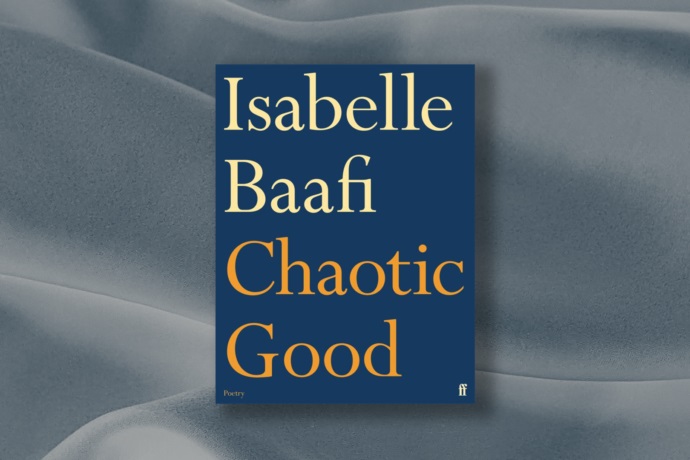
| Title | Chaotic Good |
| Publisher | Faber & Faber (UK) / Wesleyan University Press (US) |
| Year | 2025 |
| Genre | Poetry / Debut Collection |
| Awards | Forward Prize for Best First Collection 2025 |
| Also recognised | T. S. Eliot Prize (shortlisted), Seamus Heaney First Collection Poetry Prize 2026 (shortlisted), Dylan Thomas Prize 2026 (longlisted), Guardian Book of the Year, Poetry Book Society Recommendation |
Chaotic Good is structured in five sections, each opened by a poem named after a scientific, psychological, or sociological “effect” — an observable principle governing how the world works. The effects include the Kuleshov effect, the Mpemba effect, the bystander effect, the butterfly effect, and the horizon effect. Together, they form a framework through which the collection examines power, memory, childhood, violence, and escape — framed specifically by the story of a woman leaving a toxic marriage.
The Kuleshov effect, from cinematic theory, was the first to enter the collection. It is an editing principle in which the same neutral image takes on different emotional meaning depending on what surrounds it. For Baafi, it became a way to think about how a child’s identity is shaped not by who they are in isolation but by their context — the images they are placed beside, the meanings imposed from outside. The Mpemba effect — a chemical phenomenon in which hot water freezes faster than cold — offered her a language for how a relationship can cool even as it intensifies, how lives can defy their expected trajectories. The title Chaotic Good draws on a moral alignment category familiar from role-playing games, but Baafi’s use of it is far more charged than it might first seem. She has spoken about how women who reject oppression or patriarchal systems have historically been called unruly, deemed chaos. She was thinking about chaos as a precursor to creation — like fire, which destroys but also purges and gives way to new life — and about the strange, generative fertility that can live inside periods of upheaval.
The book moves backward in time, the first section set during adulthood and the second reaching back into childhood, dramatising what Baafi calls the tension between inevitability and free will — the codependent relationship between knowing what is going to happen and still having to live through it in real time.
The collection received extraordinary praise. Jane Draycott described it as exploring, with formal dexterity and lyrical precision, the complicated pathways of suspicion and uncertainty and the simultaneous possibilities of threat and beauty. Rachel Long called it wise-hearted and deft. Will Harris described its formal pressures as creating a kaleidoscopic intensity that brings newly beautiful and painful shapes into focus with each turn of the chamber.
“My greatest hope with this book is that anyone who has ever been in an abusive situation — romantic or otherwise — will know how valuable they are, and that they have the power to create the life they dream of.”
— Isabelle Baafi, in conversation with the Forward Arts Foundation
The Writing Journey
The journey to Chaotic Good was not a straight line from ambition to publication. It was built over years of competition entries, editorial work, fellowship memberships, close reading of other poets, and a willingness to produce work in whatever circumstances the day allowed — including, in one case, a month of morning writing sessions in a rented cottage in rural England, far from anyone who knew her.
Baafi’s process does not follow a single method. For formally constrained poems — the golden shovels, pantoums, and sestinas that appear throughout the collection — she works linearly, sitting down and writing from start to finish. But for most poems, she begins with an uncomfortable truth she cannot resolve, free-writing for up to an hour, asking herself questions, following prompts, and then extracting the lines and images with the most resonance to shape a poem from those fragments. Editing, in her account, is a separate process entirely — one that can take days, weeks, months, or even years.
She has described the winter of 2022 as a turning point. During that difficult period, her mind felt too splintered to write in the usual way. The cottage and its enforced stillness gave her something else: a method of catching herself before consciousness fully settled in, of writing from a prelogical state that produced things she would never have arrived at through deliberate craft alone. Many of the collection’s most distinctive poems came from that month.
One guiding principle emerged from that period and stayed with her: she never considers a poem finished until she has written something that surprised her. Because, as she has put it, a poem is a discovery. If nothing changes in it, why does it need to exist? And if writing it does not change the writer, why write it at all?
Chaotic Good was published by Faber & Faber and Wesleyan University Press simultaneously in 2025. That same year it won the Forward Prize for Best First Collection. It was shortlisted for the T. S. Eliot Prize 2025 and the Seamus Heaney First Collection Poetry Prize 2026, longlisted for the Dylan Thomas Prize 2026, named a Guardian Book of the Year, and selected as a Poetry Book Society Recommendation.
The Wit
What makes Isabelle Baafi exceptional as a poet is not only that she has chosen difficult subject matter — domestic violence, erasure, power, memory, race — but that she has built an intellectual architecture around that subject matter rigorous enough to hold the full weight of feeling without collapsing into sentiment.
The “effect” poems at the centre of the collection are a case in point. Each scientific or psychological principle she selects is genuinely apt, genuinely illuminating — not decoration but structure. The Kuleshov effect as a way of understanding how identity is contextually imposed on a child. The bystander effect as an honest account of collective failure in the face of visible harm. The butterfly effect as a reminder that every daily choice reverberates far into a life. These are not metaphors borrowed for atmosphere. They are intellectual frameworks that genuinely extend what the poems can say.
She has also been unusually candid about the tension between form and feeling that drives her practice. She loves working with formal constraints — not because they impose order, but because they create pressure, and pressure produces discovery. You end up surprising yourself, she has said, because you don’t know what you’re going to say or how things will come together. The sestina, the specular poem, the mirror poem and the contrapuntal are, in her work, not showcases of technique but instruments of investigation.
And then there is her understanding of what a collection is for. Baafi has spoken openly about her greatest hope for Chaotic Good: that anyone who has ever been in an abusive situation will know how valuable they are and that they have the power to create the life they dream of. This is not a poet writing toward prestige. It is a poet writing toward the person reading alone, wondering whether their own story is worth surviving.
“I never feel like a poem is done until I’ve written something that has surprised me. Because a poem, really, is a discovery.”
— Isabelle Baafi
What She Teaches Us
If you have been putting off writing because the conditions are not right, because your thoughts feel too disordered, because you do not know what you are trying to say, here is what Isabelle Baafi teaches you. She wrote some of her best poems half-asleep in a rented cottage in winter, fifteen minutes at a time, describing her dreams before her brain was fully awake. She did not wait for clarity. She trusted the process of showing up and letting the language lead.
She teaches you that form is not a cage. It is a way in. A constraint gives you something to push against, and in pushing, you find things you would never have found on the open page. She teaches you that the sestina and the pantoum and the golden shovel are not old-fashioned exercises. They are tools for discovery that have survived because they work.
She teaches you that a debut does not have to arrive fast. Baafi published her pamphlet in 2020, competed in prize after prize, edited literary journals, mentored in fellowship programmes, and built the craft for years before her full collection was ready. And when it was ready, it won one of the biggest poetry prizes in the world.
She teaches you, most importantly, that specificity in pain is not self-pity — it is generosity. She wrote deeply and precisely from her own life, from the aftermath of a toxic relationship, from childhood, from the experience of being a Black woman navigating language and power, and the result is a book that readers far beyond her own story have recognised themselves in. Specificity, written with enough honesty and enough care, always arrives at the universal.
The Invitation
There is a book inside you that only you can write. Isabelle Baafi wrote hers in morning fragments in a Wiltshire cottage, in years of competition entries that slowly sharpened her into the poet she needed to be, in editing sessions that stretched over months and years until each poem had surprised her enough to be finished.
She wrote without waiting for the right moment. She wrote through the tumult. She wrote because the story, the real one underneath the silence, would not leave her alone.
Your story is waiting. Your readers are waiting. Your published book is waiting to exist in the world. You do not need perfect conditions. You do not need to wait until you feel ready. You need to begin, and then to keep going.
When you are ready to take your manuscript from idea to published, ACEworld is here. We help Nigerian authors bring their books into the world, professionally, globally, and with the care that every story deserves.
Celebrating Gen Z Authors is a weekly editorial column on the ACEworld Blog. To nominate a Gen Z author for a future edition, send a DM to @aceworldp on Instagram. Chaotic Good is available via Faber & Faber (UK) and Wesleyan University Press (US)
.